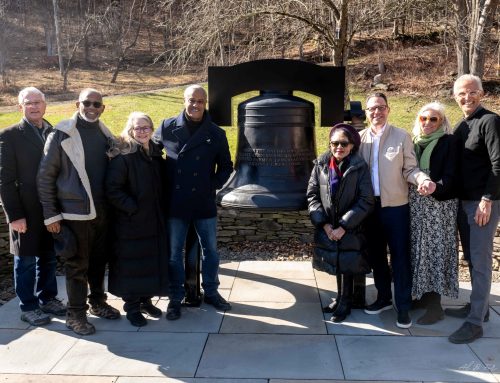

“Liberty and Legacy”
The Dennis Farm Charitable Land Trust Celebrates the United States’ 250th Birthday
August 15, 2026
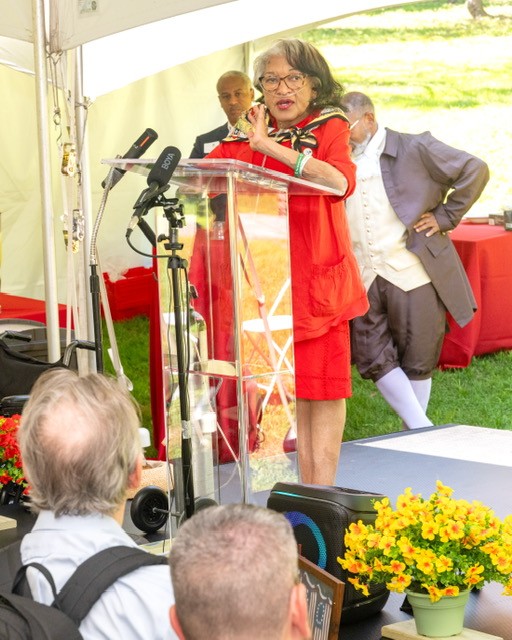 Good afternoon, everyone. Thank you for celebrating our nation’s 250th birthday year with us, in this beautiful setting. This is a joyous occasion. I love the United States, and I love the Dennis Farm—it’s a part of me. This year also marks the 25th Anniversary of the Dennis Farm Charitable Land Trust. I can’t believe how quickly the time has passed—and how we’ve grown. The property was overgrown and covered in vines right down to Creek Road when we began. Thanks to John, the grounds have been restored to their former beauty. We’ve hosted visitors and had numerous programs here. The vision I shared with my late aunt, when we founded the Trust a quarter century ago, has largely come to life, with the help of our spectacular team and partners. My only disappointment is that the house restoration is not complete. We’re making progress, though, moving closer to our goal and should be able to make an announcement soon, in that regard. In the meantime, we’re still funding raising, so spread the word. I hope to see the house completed and open to the public while I’m still around to appreciate it.
Today gives us an opportunity to look to the past for inspiration, as we move into the future. Those of you who know me, know that my mantra is “Proceed in the positive.” These words symbolize The Dennis Farm. Like a silent sentinel, the Dennis Farm has witnessed the passage of time with all its challenges and changes, yet it remains steadfast. From our ancestors Prince and Judith Perkins and Henry and Angeline Perkins Dennis, the men and women who settled, cultivated and expanded this Farm—proceeded in the positive, during times when the United States didn’t even recognize the rights of people of African heritage, and when racial hatred and discrimination were acceptable. They didn’t let that deter them, though. Instead, they looked to the light, “proceeded in the positive” rather than being dragged down by the negative, grateful for the opportunity to own land and live on it.
Of course, they couldn’t have thrived if it weren’t for the surrounding community that respected my ancestors and treated them as valued neighbors. This is one of the untold stories in American history—and a positive one. Descendants of some of my ancestors’ neighbors—dating back more than 200 years—are here today and I’d like to recognize them, in alphabetical order—please stand, Dan Fassett; Joanne Gere; Dave Palmer, Jennifer Tiffany, and Richard Zick. If there are descendants of any other neighbors dating back 200 years, will all of you please stand, too. It is rare in the US for neighbors to know one another this long. Maybe your ancestors even heard Prince Perkins play the fiddle in the old days.
The Perkins family, our 4x-great grandparents, arrived in 1793, when George Washington was still President. The Dennis family arrived in the region in 1818, having come from Concord, MA where they lived during and after the colonial period, and then Vermont, before and after the War of 1812. So, I understand American History, not only through narratives in history books, but by imagining it through the eyes of my ancestors in their everyday lives. This gives me hope for the future because they lived and survived times far more difficult than ours.
It is fitting that my late aunt, who co-founded The Dennis Farm Charitable Land Trust with me, was named Hope, Hope Dennis. Hope strengthens us during challenges. Hope sees beyond what is, to what can be. Hope leads us to what is possible. Certainly, the United States and the family faced adversity over the past more than 200 years. Two Fugitive Slave Acts, one passed in 1793, when the Perkins family arrived here, and another in 1850, put even free African Americans at risk of being kidnapped and sold into slavery. Fortunately, the Underground Railroad was active in the Northeast PA, guiding enslaved people to freedom. In 1838, Black men landowners who had been able to vote in Pennsylvania since 1790, lost that right when, in1837, the PA Constitution was amended to exclude them—by inserting the word “white” in front of “free men.” With that one word, landowners Prince Perkins and his son, William Perkins, James Dennis and his son, Henry Dennis, and Bristol Budd Sampson were all disenfranchised. Only Henry Dennis—our 2x-great grandfather lived long enough to see his right to vote restored, when Congress passed the 15th Amendment in 1870. Nonetheless, each man proceeded in the positive, rising with the sun each morning, working until sunset, tending to their livestock and fields, educating their children, having faith.
It is unconscionable and unbelievable to witness voting rights being gutted today–in the 21st century–that laws protecting voting rights have been overturned to disenfranchise Black voters, just as they were in the South at the end of Reconstruction. When one person’s rights are squashed, everyone is in danger. It’s a slippery slope.
The motto of The Dennis Farm Charitable Land Trust is “Faith, Family, Farm and Freedom.” (For a small donation you can buy a wristband with the motto on it.)
Faith—because from Judith Perkins’ devout piety to the Dennis Family Bible, to Henry Dennis’ books on faith—to Darryl, Lonnie and I texting prayers to one another—faith has been central to the Perkins-Dennis family’s lives.
Family—because the Perkins-Dennis Family has always been a close, loving family who look out for one another. Family, after all, is the first social unit, followed by community.
Farm—because The Dennis Farm is our touchstone, our North Star, constant and never changing. I was a baby here and now I am une dame d’un certain âge, “a woman of a certain age,” as the French say. Yet, as it was for previous generations, the Farm remains serene on this hillside, seeing us come and go.
Freedom because the Farm is one of the few places in US History where the Declaration’s assertion that “All men are created equal,” was actualized from the earliest days of the Republic. Here, on this Farm, all people were and have been free, regardless of race.
The Bible, Hebrews 11, says “Faith is the substance of things hoped for, the evidence of things not seen.”
There’s that powerful word “Hope” again. Faith, hope and love of family and community enabled our ancestors to overcome the prejudices and injustices of their times—and prevail. This a lesson for all of us in today’s troubled and divisive times. We Americans cannot lose hope–we cannot turn against one another. Rather, we are to have faith, hope and love for one another, as my ancestors did. These are the keys to a brighter, prosperous future—being open, not closing off, moving toward the light even when we cannot see the light.
Human beings are prone to take two steps forward and one step back. Progress seldom flows smoothly. Even streams encounter rocks and stones along the way. This makes Democracy a fragile thing because Democracy depends on “we the people,” depends on imperfect human beings and our tendency to move two steps forward only to trip, fall and take one step back. Yet, our democratic republic has survived so far, has withstood a Civil War, two World Wars, attacks from without and within, and along the way amended the Constitution to include the rights of African Americans and women whose rights were excluded in 1776. It hasn’t been steady progress, but this great nation has made progress, nonetheless. We can build on that progress, if we choose.
We’ve maintained our democratic republic for 250 years, a unique astonishing achievement in human history. Now we are at a fork in the road. Which way shall we turn? Whether or not we leave our democracy intact for future generations, depends on what we do now. We are not helpless. We can come together or allow ourselves to be torn apart. We can choose kindness or hatred, faith or fear, generosity or greed. It’s our choice. Democracy, like a farmer’s field, must be tended or else it will grow fallow, wither and die.
In 1787, as Benjamin Franklin was leaving the Constitutional Convention in Independence Hall, a woman asked him, “Do we have monarchy or a republic?” He wisely replied, “A republic, if you can keep it.” If you can keep it. Wow! Franklin understood the fragility of democracy and human nature.
The Dennis Farm and the community in which it thrived all those years ago symbolize what is possible. Let the story, the history of the Farm inspire you to help keep our Republic, to celebrate what was achieved here—on this Farm, in this community, and to believe in the future of equality, justice and freedom for all. Liberty is our collective legacy. Listen to your better angels. Proceed in the positive.